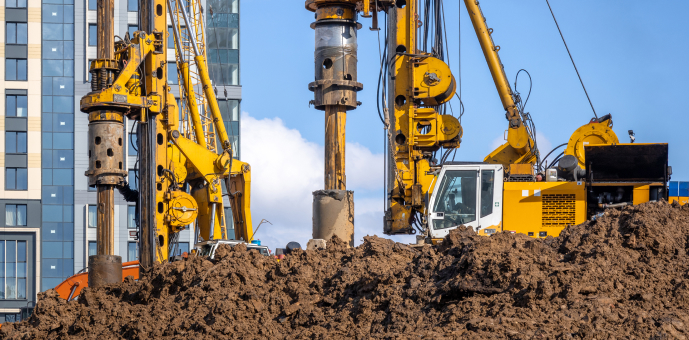
Rigid Inclusions are an innovative ground improvement solution designed to increase the bearing capacity of weak soils while providing effective settlement control. As a sustainable and economical alternative to traditional piling, the system creates a reinforced composite ground mass capable of supporting a wide range of structures.
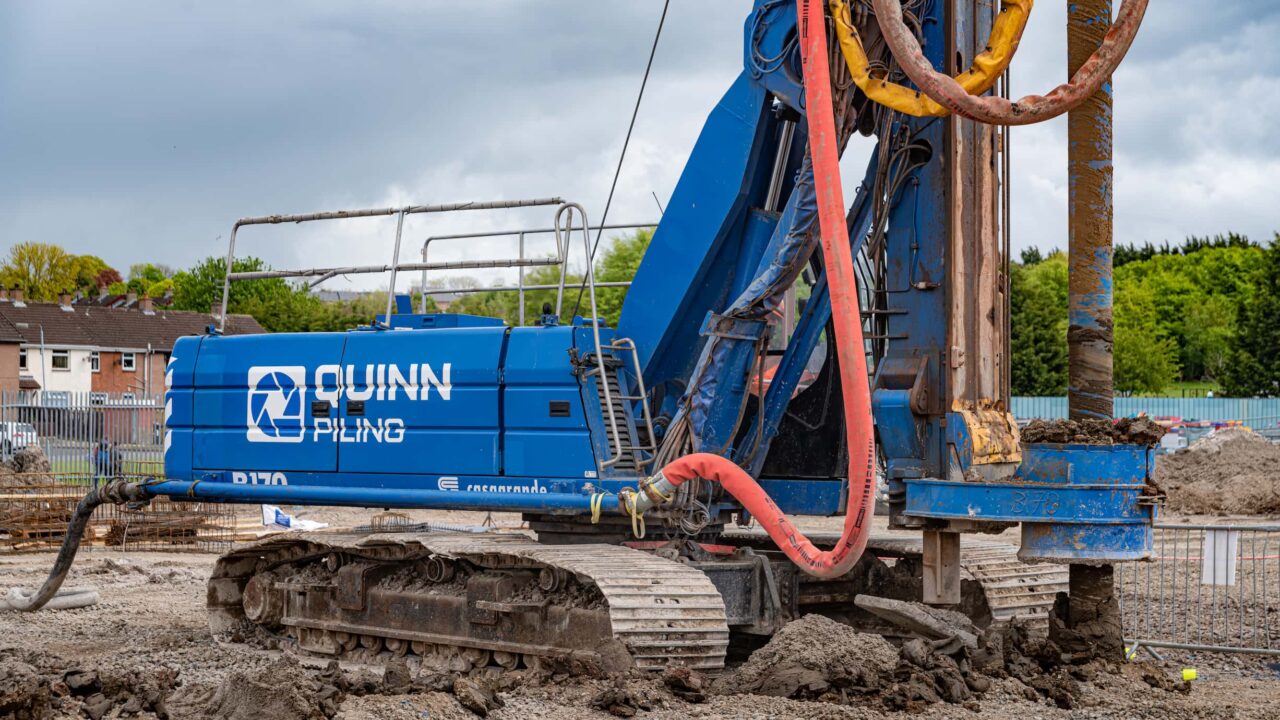
Installation
Rigid Inclusions are installed using either a rotary displacement hollow auger or a vibrated steel tube, depending on the ground conditions and project requirements. The displacement process densifies the surrounding soil while minimising spoil generation, making it particularly suitable for environmentally sensitive and brownfield sites.
Once the required design depth or installation resistance has been achieved, high-slump grout or concrete is pumped continuously through the hollow stem under positive pressure as the tool is withdrawn, forming the inclusion.
Following installation, a granular Load Transfer Mattress is constructed above the inclusions to distribute structural loads into the reinforced ground, allowing conventional strip, pad or raft foundations to be constructed efficiently.
Rigid Inclusions are particularly effective in soft clays, peat and other compressible soils where conventional shallow foundations would not normally be suitable, allowing ground-bearing slabs and traditional foundations to be used in place of deep piling solutions.
Our Capability
Quinn Piling delivers specialist Rigid Inclusion solutions across Ireland and the UK, providing cost-effective ground improvement for commercial, industrial and infrastructure developments.
Working alongside our wider piling and ground improvement capabilities, we design and install Rigid Inclusion systems tailored to the specific ground conditions and loading requirements of each project.
Our Rigid Inclusion capability includes:
- Commercial and residential developments
- Industrial facilities
- Distribution and logistics centres
- Road and railway embankments
- Tanks and storage structures
- Retaining structures
- Ground-bearing slab support
- Large-scale ground improvement projects
Key Benefits
Rigid Inclusions offer a highly efficient alternative to traditional piling in weak ground conditions.
Key benefits include:
- Economical alternative to deep piling
- Excellent settlement control
- Suitable for very soft clays and peat
- Minimal spoil generation through displacement installation
- Allows the use of conventional strip, pad and raft foundations
- Fast installation with production rates of up to 2,500 metres
per week - Improves embankment stability and reduces construction
programmes - Suitable across a wide range of ground conditions
Applications & Performance
Rigid Inclusions are commonly used where weak or compressible soils require improvement before construction can commence.
Typical applications include:
- Commercial and residential developments
- Industrial and warehouse facilities
- Road and railway embankments
- Storage tanks and silos
- Ground-bearing floor slabs
- Retaining structures
- Infrastructure projects
- Brownfield regeneration
- Large-scale earthworks and platform construction
Quinn Piling can install Rigid Inclusions to depths ranging from 2.5 metres to 25 metres, with typical diameters between 300 mm and 600 mm, depending on the project requirements and ground conditions.
Designed in conjunction with a granular Load Transfer Mattress, the system provides an efficient, economical and sustainable solution for improving bearing capacity while controlling settlement in weak ground.